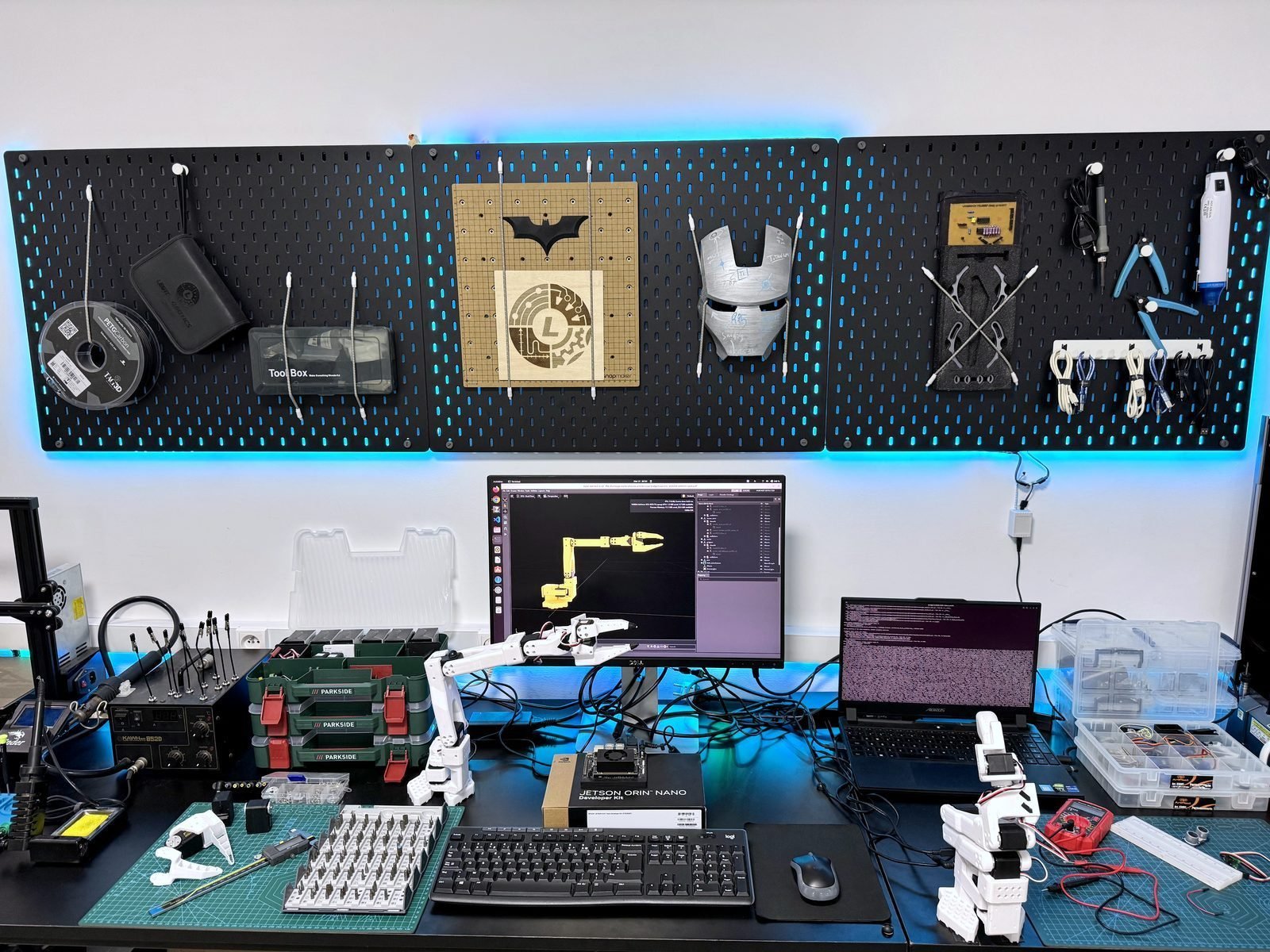
Your university teaches theory. We give you the lab, the hardware, and the hands-on experience that your program doesn't have time — or equipment — to offer. Work with NVIDIA Jetson, robotic arms, digital twins, and real AI deployment pipelines alongside PhD researchers who do this for a living.
Un aperçu de ce programme en action — projets, réalisations et démonstrations.


Four advanced tracks designed to fill the exact gaps between university theory and what industry actually demands from robotics and AI engineers today.
The most important shift in AI is happening right now: intelligence is moving from the cloud to the device. Physical AI means robots that see, reason, and act in real time — without sending data to a server. Deploy deep learning models directly on NVIDIA Jetson hardware, optimize inference with TensorRT, build real-time computer vision pipelines, and integrate Large Language Models into physical robotic builds.
Most engineering students learn kinematics from equations on a whiteboard. Here, you build the arm, calibrate it, program it, and watch it fail — then fix it. Assemble the full mechanical structure, wire servo motors, implement forward and inverse kinematics, program teleoperation protocols, and integrate AI for autonomous pick-and-place tasks.
Before Tesla builds a robot, they simulate it. Before NASA lands a rover, they simulate it. Build photorealistic digital twins in NVIDIA Omniverse, simulate physics-accurate environments in Isaac Sim, train reinforcement learning agents in virtual worlds, and transfer learned behaviors to physical hardware (sim-to-real).
The integration point. Take on real, open-ended engineering challenges that demand the seamless combination of everything: AI, electronics, mechanical design, manufacturing, and software. Designed specifically for students working on capstone projects (PFE), Masters theses, or PhD research who need access to professional fabrication and AI infrastructure.
Every session follows the same process used by professional engineering labs.
No introductory lectures. No slides. You touch the Jetson, the arm, the printer from session one. Theory is embedded in the build process.
Every session supervised by an engineer or PhD researcher who publishes, builds, and reviews your work like a research advisor.
Maximum 8 students per session. Everyone gets dedicated equipment access and direct mentor feedback.
You don't "complete modules." You complete engineering projects of increasing complexity integrating CAD, electronics, AI, and programming.
Trained to use Claude, Gemini, and ChatGPT as professional engineering tools: debugging code, researching datasheets, optimizing models.
Design, print, test, break, redesign, reprint. Speed of iteration is speed of learning. Failure is the engineering process.
The most powerful compact edge AI computer. Same hardware powering autonomous vehicles and industrial inspection systems worldwide.
Create photorealistic digital twins. Simulate physics, lighting, sensor feeds, and AI behaviors in virtual environments.
Physics-accurate robotics simulation. Train RL agents, test perception stacks, and validate control systems in simulation.
Multi-axis robotic arm for advanced kinematics, calibration, teleoperation, and AI-driven manipulation research.
Industry-standard CAD platform for parametric mechanical design, assembly modeling, stress simulation, and manufacturing-ready drawings.
Ender-3 Pro and Snapmaker A350T (FDM) for structural prototyping. Elegoo Saturn S (SLA resin) for high-precision components.
Python for AI, data processing, and high-level control. C++ for embedded systems, real-time processing, and performance-critical applications.
The Robot Operating System — the industry standard middleware for building modular, distributed robotic systems.
Configure NVIDIA Jetson, optimize deep learning models with TensorRT, and run real-time inference on physical robots.
Assemble, wire, calibrate, and program multi-axis robotic arms — from mechanical assembly to AI-driven autonomous operation.
Build photorealistic simulations in NVIDIA Omniverse and Isaac Sim. Train AI in virtual worlds and deploy to physical hardware.
Define a problem, design a solution, prototype it, test it, and deliver a working system with publication-quality documentation.
Walk into interviews with deployed AI models, calibrated robotic arms, printed prototypes, and simulation environments. Not just grades — proof.
Possess the practical skills to contribute meaningfully to academic robotics and AI research at the Masters and PhD level.
Deep, focused work sessions. Twice per week.
Small cohorts ensure everyone gets dedicated equipment access and direct mentor feedback.
4-month semesters or project-based duration. Aligned with your university schedule.
Basic Python + university-level engineering fundamentals. We build from there.
Technical terms in English. Instruction in French or English based on cohort preference.
Engineering students, Masters/PhD candidates, PFE students needing lab access, and self-taught engineers seeking hands-on experience.
Book a visit to see our university students deploying AI on NVIDIA Jetson, calibrating robotic arms, and building digital twins — the skills that separate an engineer from a graduate.